Apply Stain Augmentation
Overview
Problem solved: augment H&E-like tiles by perturbing stain channels rather than only applying generic RGB transforms.
Use this example when:
- you are training a model on histopathology tiles,
- stain variation across labs or scanners matters,
- or you want image-dependent stain matrices instead of a single fixed transform.
Why This Approach
StainAugmentor is an Albumentations transform.
It separates an image into stain space, perturbs each stain channel, and then reconstructs the RGB image.
You can provide either:
- a fixed stain-conversion matrix,
- or a callable that estimates the matrix from each image.
Bundled example input
The figure below shows the two augmentation modes discussed on this page.
The middle panel follows the adaptive-matrix workflow, while the right panel follows the fixed-HE workflow shown later on this page.
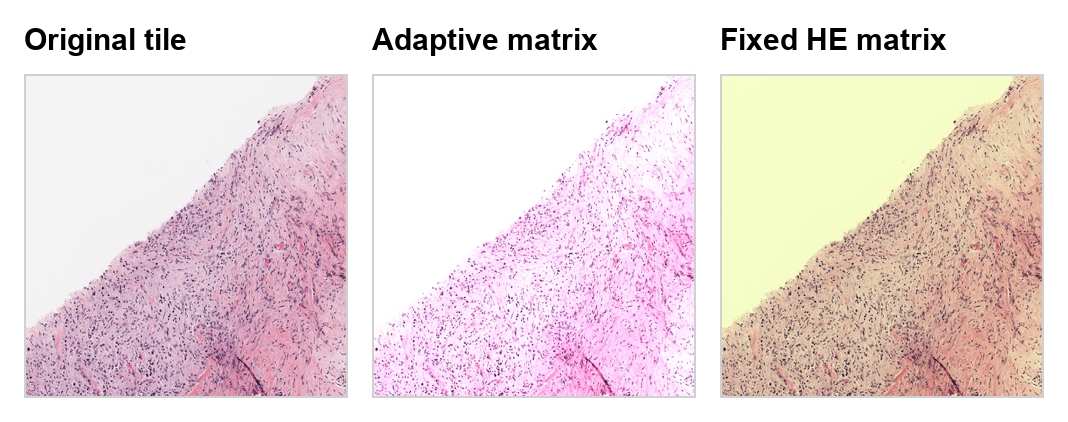 Using one real crop for all three panels makes it easier to see how the adaptive and fixed-matrix variants differ in practice.
Example With An Adaptive Matrix
import numpy as np

from ratiopath.augmentations import StainAugmentor, estimate_stain_vectors
from ratiopath.augmentations.estimate_stain_vectors import HE
from ratiopath.openslide import OpenSlide

with OpenSlide("slide_a.tiff") as slide:
    tile = slide.read_tile(
        x=9216,
        y=7168,
        extent_x=2048,
        extent_y=2048,
        level=0,
    )

augmentor = StainAugmentor(
    conv_matrix=lambda image: estimate_stain_vectors(image, HE),
    alpha=0.05,
    beta=0.05,
    p=1.0,
)

augmented_tile = augmentor(image=tile)["image"]
Expected outputs
augmented_tile stays in the same image space as the input tile:
- shape:
(2048, 2048, 3) - dtype:
uint8
The pixel values change, but the tile dimensions and layout do not.
Under the hood
estimate_stain_vectors applies an optical-density transform, discards unsuitable pixels, and estimates a stain basis from the remaining signal.
StainAugmentor then samples multiplicative and additive perturbations for each stain channel before reconstructing the RGB image.
This is different from ordinary color jitter because the perturbation happens in stain space rather than directly in RGB.
Example With A Fixed Matrix
from ratiopath.augmentations import StainAugmentor
from ratiopath.augmentations.estimate_stain_vectors import HE

augmentor = StainAugmentor(
    conv_matrix=HE,
    alpha=0.02,
    beta=0.02,
    p=1.0,
)
Expected outputs
The fixed-matrix version produces the same kind of output array as the adaptive version. The difference is only in how the stain basis is chosen, not in the output tensor shape or datatype.
Use the fixed-matrix version when you want deterministic stain semantics across tiles and the adaptive version when slide-to-slide stain variation is large.
Where This Fits In A Pipeline
This is usually a training-time step, not a Ray metadata step. Common usage looks like:
- build a tile dataset with
read_slide_tiles, - load tiles into a model input pipeline,
- apply
StainAugmentorduring training augmentation.